
Lady of Lincoln by Rachel Elwiss Joyce, ISBN: 978-1919337913, Hedgehog Books, 2025
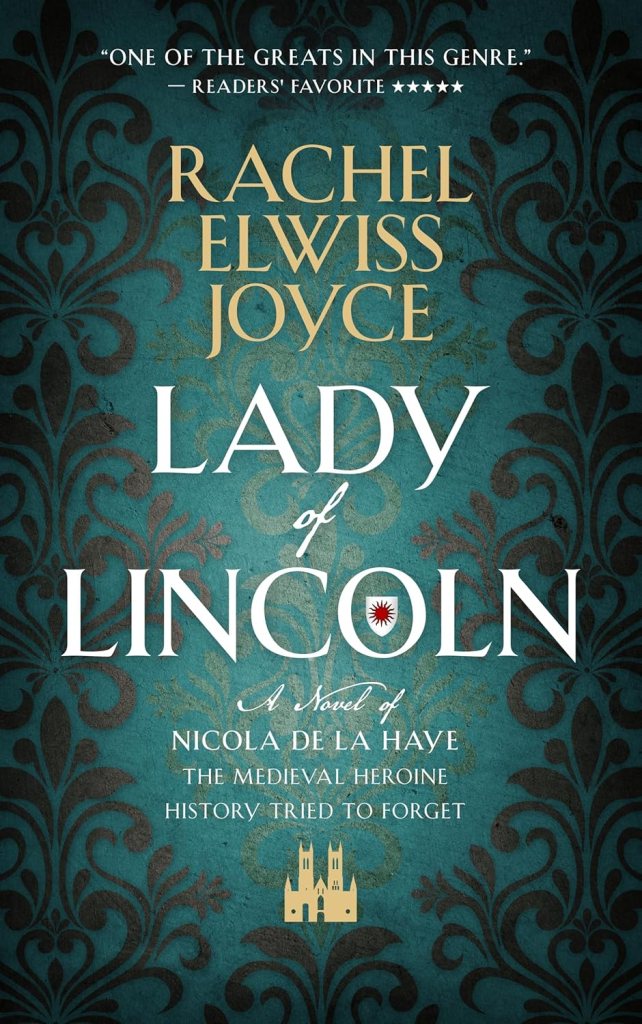
Nicola de la Haye, Constable of Lincoln Castle, was one of the most remarkable women in medieval England — yet her story has been largely consigned to the back pages of historical record. From her youth in the late twelfth century, this debut novel traces the earlier chapters of her remarkable life, long before the siege and civil war that would make her famous.
Rating: 3/5 stars
Nicola de la Haye is one of the most remarkable women in medieval English history — the Constable of Lincoln Castle, a survivor of siege and civil war, and a figure whose extraordinary life has been consistently undervalued by history. Her story is most known for her role during the reign of King John and the Magna Carta, but that was when she was an older woman — the earlier chapters of her life have rarely been told in historical fiction. Rachel Elwiss Joyce’s debut sets out to remedy that, and in several important respects it succeeds.
A Heroine Worth Recovering
The novel’s greatest strength is Nicola herself. Her struggle against the constraints of her gender, her grief, and her desire to shape her own future feels honest and raw — this is not a sanitised portrait of a medieval heroine but a fully human one, shaped by loss, difficult choices, and the relentless pressure of a world that has very little interest in what she wants. We see Nicola transform from a naive young woman into a fiercely determined mother and wife who would do anything to protect her family, her friends, and her family home — and that arc is convincingly rendered throughout.
Medieval Women and the Jewish Community
The depiction of medieval women’s lives is equally impressive. Joyce clearly understands the period and the constraints it placed on women of all social classes, giving us not only Nicola interacting with the typical nobility but also the common people — a breadth of perspective that gives the novel genuine social texture. The historical research underpinning the story is evident on every page, and the world of late twelfth-century England feels convincingly realised.
Particularly noteworthy is the novel’s exploration of Nicola’s relationship with Lincoln’s Jewish community — a dimension of medieval social life that historical fiction rarely addresses with any depth. Lincoln did have a significant Jewish community in this period, and the interactions Joyce portrays shed interesting light on the complex and often precarious position Jews occupied in Plantagenet England. How closely this reflects the historical record I cannot say with certainty — readers with more specialist knowledge may be better placed to judge — but as a narrative choice it enriches the story considerably and speaks well of Joyce’s ambition as a historical novelist.
Where the Book Struggles
The reservations are significant, however. The relationship between Nicola and her first husband William FitzErneis — a penniless knight she chooses over her father’s wishes and King Henry II’s blessing — never quite convinces. The emotional logic of Nicola’s attachment to William is insufficiently developed, which means that a relationship central to the first half of the novel lacks the weight it needs. For a story so dependent on the reader understanding and believing in Nicola’s choices, this is a meaningful gap.
The other issue is the novel’s handling of its sex scenes, which will divide readers sharply. There are several explicit scenes throughout, and at least one towards the end of the book crosses into territory that many readers — myself included — will find uncomfortably graphic. Those who are sensitive to this kind of content should be forewarned; I found myself skipping several pages. It is a significant tonal misjudgement in an otherwise serious and thoughtful work of historical fiction.
Lady of Lincoln is a flawed but genuinely promising debut. Nicola de la Haye is a protagonist who deserves to be better known, and Joyce’s commitment to recovering her story is admirable. With tighter emotional development of the central relationships and a more measured approach to its explicit content, this could have been an excellent novel. As it stands, it is an interesting and often compelling one.
I received an advance copy of this book via NetGalley.



Leave a comment