
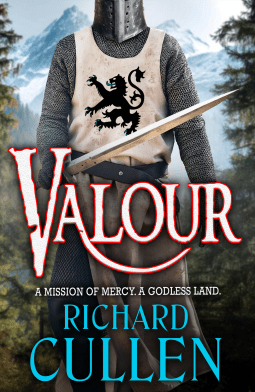
ISBN: 9781836033707 Boldwood Books, 15th August 2025
Estienne Wace has found purpose serving at the Teutonic Knights’ fortress of Rosenau, having earned respect through his unflinching courage. When a Christian mission led by Fabrisse of Avallon arrives, determined to convert a pagan clan beyond the Carpathian Mountains, Estienne’s warnings of danger fall on deaf ears.
News soon arrives of Fabrisse’s capture, and Estienne, along with a small band of knights, must undertake a desperate rescue mission through hostile territory where he will face trials beyond endurance.
Rating: 4/5 stars
After the mixed experience of Crusade, I came to Valour with cautious optimism — and Richard Cullen rewarded that optimism handsomely. The third instalment in the Chronicles of the Black Lion is, in my view, the strongest entry in the series so far, addressing many of the pacing issues that held its predecessor back and delivering a story that is both more focused and more emotionally engaging.
The shift in setting is an immediate and very welcome change. Swapping the familiar terrain of the Holy Land for the wild borderlands of thirteenth-century Hungary and the Carpathian Mountains gives the novel a freshness and unpredictability that Crusade sometimes lacked. This is a corner of medieval history that rarely receives fictional attention, and Cullen makes the most of it — the landscape feels genuinely forbidding, the political tensions between Christian and pagan worlds are handled with nuance, and the sense of Estienne operating far from anything familiar adds real texture to the story.
The Fabrisse storyline is a particular highlight. As a holy woman whose faith drives her into mortal danger, she is a more interesting and more morally complex figure than some of the supporting characters in previous books, and her dynamic with the sceptical, battle-hardened Estienne gives the novel an engaging central tension beyond the action sequences themselves. The two characters bring out different facets of each other in ways that feel earned rather than contrived.
Estienne himself continues to develop convincingly. The young squire of Rebellion feels like a distant memory — this is a man shaped by everything the previous two books have put him through, and that accumulated experience shows in how he moves through the world and makes his decisions. Cullen is clearly invested in this character’s long arc, and it shows.
The pacing is tighter than Crusade throughout. The action sequences are visceral and well-constructed, and the novel avoids the mid-section drag that undermined its predecessor. There is a propulsive quality to the storytelling here that keeps the pages turning consistently.
Valour is a confident and accomplished third entry in a series that is finding its stride. For readers who persevered through the slower moments of Crusade, this is the reward — and for those new to the series, it is a reminder that Cullen is a writer worth following.
I received an advance copy of this book via NetGalley.




Leave a Reply