
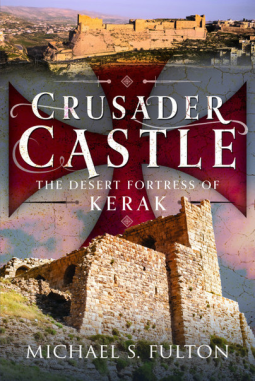
Crusader Castle: The Desert Fortress of Kerak by Michael S. Fulton
ISBN: 9781399091268, Pen and Sword Military , 2024
The formidable strongholds built by the crusaders are among the most iconic castles of the Middle Ages, and the castle of Kerak, in modern Jordan, is one of the largest, most imposing, and best preserved of them all. Tracing over 800 years of history, this study follows Kerak from its construction in the twelfth century through the Crusader period, its fall to Muslim forces, and its long subsequent history under Ayyubid, Mamluk, and Ottoman rule.
Rating: 4/5 stars
The castle of Kerak is one of the most extraordinary fortresses in the medieval world — and for most Western readers, one of the least familiar. Michael Fulton’s detailed study goes a long way to correcting that, and for readers with an interest in the Crusades and medieval military history, it is a genuinely valuable and largely absorbing piece of work.
A Fortress Worth Knowing
Fulton takes the reader through the early military history of the castle from its construction in the 1140s by Pagan the Butler, through the provocative and reckless career of Reynald of Châtillon — one of the most consequential figures of the entire Crusader period — and on through its eventual fall to Muslim forces. He also traces its later history under Muslim rule, when it served as a treasury for the Ayyubid and Mamluk sultans of Egypt, before falling into decline under the Ottomans. This sweep of 800 years gives the book admirable breadth, and Fulton’s decision to place Kerak within the wider context of Crusader history rather than treating it as an isolated monument is one of its greatest strengths.
Military History and Broader Context
Fulton emphasises the military history of the castle in a way that feels natural, relevant, and understandable, bringing in a variety of historical figures to contextualise Kerak’s story and placing this architectural and historical case study into a larger international framework. The castle becomes a lens through which to understand an entire era of conflict, faith, and shifting power in the medieval Middle East. For readers interested in siege warfare and Crusader military strategy, this is exactly the kind of grounded, specific study that enriches the broader picture.
The Illustrations and Maps
The illustrations and maps are a real asset. They help the reader visualise both the castle’s layout and its strategic position in the surrounding landscape, and the chronological structure keeps the narrative clear and navigable throughout. This is the kind of well-produced supporting material that makes a real difference to the reading experience of a book like this.
Where the Book Tests Patience
That said, the book is not without its limitations. The architectural analysis, while clearly the product of serious scholarly expertise, periodically tips into a level of technical detail that will test the patience of general readers. Descriptions of specific building phases, masonry types, and structural modifications can become dense, and there are sections where the text feels somewhat repetitive — covering similar ground across different chapters. These are the natural hazards of a book trying to serve both as a narrative history and as a detailed architectural guide, and readers coming primarily for one may occasionally find themselves wading through rather more of the other than they bargained for.
The writing style is, for the most part, accessible — Fulton clearly wants to reach beyond a purely academic audience — but the occasional technical passages mean this is best suited to readers with at least some prior interest in medieval castles or the Crusades, rather than complete newcomers.
Final Thoughts
These are relatively minor complaints against a book that is thoroughly researched, genuinely illuminating, and often absorbing. Crusader Castle is an excellent resource for anyone wanting to understand Kerak in depth, and it leaves the reader with a vivid sense of why this extraordinary fortress has loomed so large in the history of the region. Highly recommended for anyone with a serious interest in the Crusades and medieval military history.
I received an advance copy of this book via NetGalley. I subsequently purchased the Kindle edition.

 The History Lady
Leave a comment