
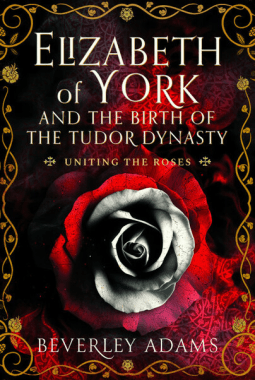
Elizabeth of York and the Birth of the Tudor Dynasty by Beverley Adams
ISBN: 9781399044158, Pen & Sword History, December 2024
Elizabeth of York has long been overshadowed by her infamous son Henry VIII and his six wives, and by her granddaughter Elizabeth I. Yet as the daughter of Edward IV, sister to the Princes in the Tower, and wife of Henry VII, she stood at the very heart of one of the most turbulent transitions in English history. This new biography sets out to restore her to her rightful place — not merely as a consort, but as a strong and influential figure in the birth of the Tudor dynasty.
Rating: 3.5/5 stars
When we think of the Tudor dynasty, our minds tend to leap straight to Henry VIII and his parade of wives, or the fierce brilliance of Elizabeth I. But what of the woman who made it all possible? Elizabeth of York has often been overlooked by Tudor historians in favour of her more famous descendants — and with this book, Beverley Adams sets out to correct that oversight. With some reservations, she succeeds.
A Queen Rescued from the Margins
Elizabeth of York’s life was one of extraordinary upheaval. The daughter of Edward IV and Elizabeth Woodville, she suffered the loss of her brothers — the Princes in the Tower — lived through the reign of her controversial uncle Richard III, and eventually became the first queen consort of the Tudor dynasty through her marriage to Henry VII. Adams traces this turbulent journey with care, from Elizabeth’s precarious childhood during the Wars of the Roses right through to her years as queen consort.
Challenging the Passive Consort Myth
One of the book’s genuine contributions is its challenge to the traditional image of Elizabeth as a passive, submissive queen. Adams makes a convincing case that Elizabeth held real influence over her husband and was a strong, well-respected figure at court — a woman Henry VII genuinely valued rather than merely tolerated. This reframing is long overdue and is the most persuasive element of the book.
The novel’s other considerable strength is its treatment of the royal marriage itself. The popular notion that Henry and Elizabeth’s union was cold and purely political is persuasively dismantled here. Adams marshals her material well to present a relationship that was, by all reasonable evidence, a genuinely affectionate one.
Where the Book Struggles
The most significant weakness is the complete absence of references or footnotes. For a work of popular history making substantive claims about one of England’s most contested periods, this is a serious omission. Readers who want to follow up on a point or interrogate a source are left with nowhere to turn.
Related to this is a tendency to lend credibility to speculative and poorly evidenced claims. At certain points, Adams cites what she describes as “new research” to support contested theories — but on closer inspection, this “research” amounts to little more than books built on rumour, revisionism, and wishful thinking. Presenting such material as though it carries genuine scholarly weight is misleading.
Speculation and Richardian Partisanship
This feeds into a broader issue: Adams occasionally allows herself to be swayed by the arguments of Ricardian partisans — those committed, sometimes at the expense of evidence, to rehabilitating Richard III. The problem with much Ricardian reasoning is that it mistakes character testimony for historical proof. That Richard may have held a virtuous motto, or been regarded fondly by some contemporaries, tells us nothing about whether he was capable of ordering politically inconvenient murders. Medieval nobles did not survive and seize power by being gentle — that is a modern, sentimental projection onto a world governed by brutal pragmatism. Evidence, not emotional advocacy, should be the historian’s standard, and Adams does not always hold that line.
Final Thoughts
Elizabeth of York and the Birth of the Tudor Dynasty is not a bad book — far from it. It is well-researched in parts, genuinely engaging, and succeeds in showing Elizabeth as a strong, influential figure rather than a mere footnote to her husband’s reign. Where it falls short is in its approach to sources and its willingness to entertain speculation as evidence. For readers new to the period it provides an accessible and enjoyable entry point — but those already familiar with the era will find the lack of rigour frustrating.
A worthwhile read with notable caveats.
I received an advance copy of this book via NetGalley in exchange for an honest review.



Leave a Reply