A medievalist watches The Pendragon Cycle: The Rise of Merlin and reads the reviews
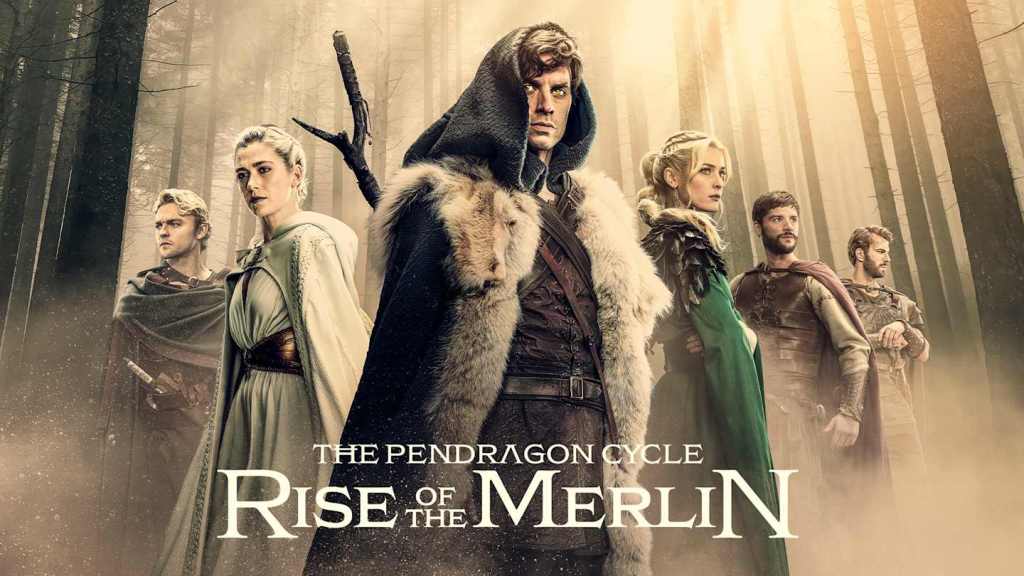
I’ve just finished watching The Pendragon Cycle: The Rise of Merlin.
And then I made the mistake of reading the reviews.
A lot of them are saying the same thing: it’s too Christian. Christianity is “ruining” the Arthurian legends. It’s pushing religion into a story that was supposed to be about magic and druids and pagan Britain.
My inner Medievalist is chuckling. Because if you took Christianity out of Arthurian legend, you wouldn’t be left with the “real” Arthur.
You’d be left with almost nothing at all.
1. We Don’t Start With Pagan Bards. We Start With Monks.
Arthur doesn’t come to us from a misty, pre-Christian oral tradition. He comes to us from churchmen writing in Latin, in monasteries, trying to make sense of Britain after Rome fell.
Gildas, c. 540 — De Excidio et Conquestu Britanniae
Gildas is our earliest witness, and he’s a monk. A furious, fire-and-brimstone monk.
He doesn’t even name Arthur. But he gives us the world Arthur will be born into: Britain after Rome, a proud, foolish British leader he calls the superbus tyrannus — the proud tyrant — who invites Saxon mercenaries in to help fight the Picts and Scots, and then loses control of them.
That tyrant becomes Vortigern in later tradition.
Gildas’s point isn’t “isn’t pagan Britain cool?” His point is theological: Britain has sinned, God is punishing Britain, and the Saxons are the punishment. The Britons win a great victory at the Battle of Badon — the battle later tradition will give to Arthur — and for Gildas, that’s not magic. That’s God giving a sinful people one last chance to repent.
And Gildas doesn’t just admonish Vortigern in the abstract. After his history, he turns and admonishes five living British kings by name — Constantine, Aurelius Caninus, Vortiporius, Cuneglasus, and Maglocunus.
Maglocunus is Maelgwn of Gwynedd.
Gildas calls him the “island dragon” — insularis draco — a king who had been a monk, left the monastery, murdered, married and divorced, and returned to his sins. He is, in Gildas’s eyes, the perfect example of a Christian king who knows better and does worse.
Here’s why that matters for Arthur:
Some scholars believe Maelgwn is the origin of Malagant.
Not proven, but the trail is tantalising. Maelgwn / Maglocunus becomes Melwas in the later Life of Gildas — a king who abducts Guinevere. Melwas becomes Meleagant / Malagant in Chrétien de Troyes’s Knight of the Cart — the villain who kidnaps Guinevere and holds her in a kingdom you can only enter by crossing the Sword Bridge.
In other words, the great Arthurian villain who steals the queen might not come from pagan myth at all. He might come from Gildas pointing his finger at a real, historical, sinful Christian king of Gwynedd and saying: you, you dragon, repent.
That’s the pattern for the whole legend. Vortigern comes from Gildas. Arthur’s Battle of Badon comes from Gildas. And possibly even Malagant, the abductor of Guinevere, comes from Gildas’s list of naughty kings.
The “pagan” villains are, once again, just medieval monks admonishing bad Christians.
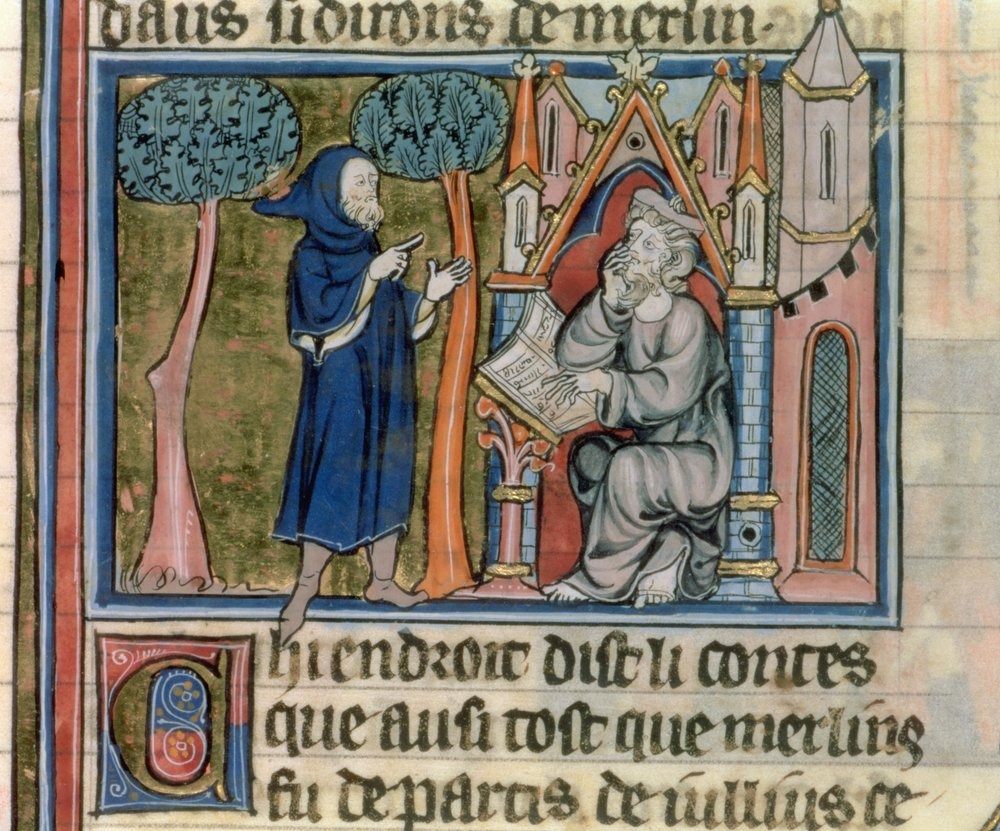
Bede, c. 731 — Ecclesiastical History of the English People
If Gildas is the angry prophet, Bede is the careful historian who makes Gildas usable for everyone after him.
In his Ecclesiastical History, Bede retells Gildas’s story of the Saxon invasion, Vortigern’s disastrous invitation, and the long war that follows. And he names the man who finally turns the tide:
Ambrosius Aurelianus.
For Bede, Ambrosius is a Roman — a survivor of the Roman Britons, “a man of modest character” — who rallies the Britons and leads them to victory at Badon. It’s the same battle Gildas mentions, but Bede gives it a leader, a name, a face.
This is crucial for Arthur, because Ambrosius becomes the template that gets split in two.
In Nennius, Ambrosius is the boy with no father that Vortigern tries to sacrifice — the boy who becomes Merlin. Nennius actually calls him Ambrosius Merlinus. That’s where the two names fuse.
In Geoffrey of Monmouth, Geoffrey takes Bede’s Ambrosius and splits him again, into two brothers: Aurelius Ambrosius, Arthur’s uncle, the good Christian king who defeats Vortigern and restores order, and Merlin Ambrosius, the prophet who advises him.
So Arthur doesn’t just appear out of nowhere. He inherits from Ambrosius. Aurelius Ambrosius is Arthur’s uncle and predecessor. Merlin Ambrosius is Arthur’s prophet and adviser. Both of them come from that one figure Bede rescued from Gildas.
And again — look at what Bede is doing. He’s not writing pagan myth. He’s writing church history. For Bede, the whole point of Ambrosius is that he’s the last Roman Christian holding the line against pagan Saxons. The Battle of Badon is God rewarding a Christian remnant.
When Geoffrey later makes Arthur the successor to Aurelius Ambrosius, he’s making Arthur the successor to Bede’s Christian Roman hero.
So the lineage is:
Gildas -> Bede -> Nennius -> Geoffrey
Gildas gives us the sinful Britain and Badon.
Bede gives us Ambrosius Aurelianus, the Christian leader at Badon.
Nennius gives us Arthur as the new Ambrosius, carrying Mary into battle, and Merlin as Ambrosius the prophet.
Geoffrey splits Ambrosius into Aurelius (the king) and Merlin (the prophet), and gives them both to Arthur.
No pagan bards needed. Just monks copying monks, for 600 years, building a Christian history of Britain.
Nennius, c. 830 — Historia Brittonum
About 300 years after Gildas, another monk — traditionally called Nennius — finally names him.
In the Historia Brittonum, Arthur isn’t a king. He’s a dux bellorum, a leader of battles, a war-leader who fights alongside the British kings against the pagan Saxons. He fights twelve battles, culminating at Badon.
And what does Nennius tell us Arthur carries into battle?
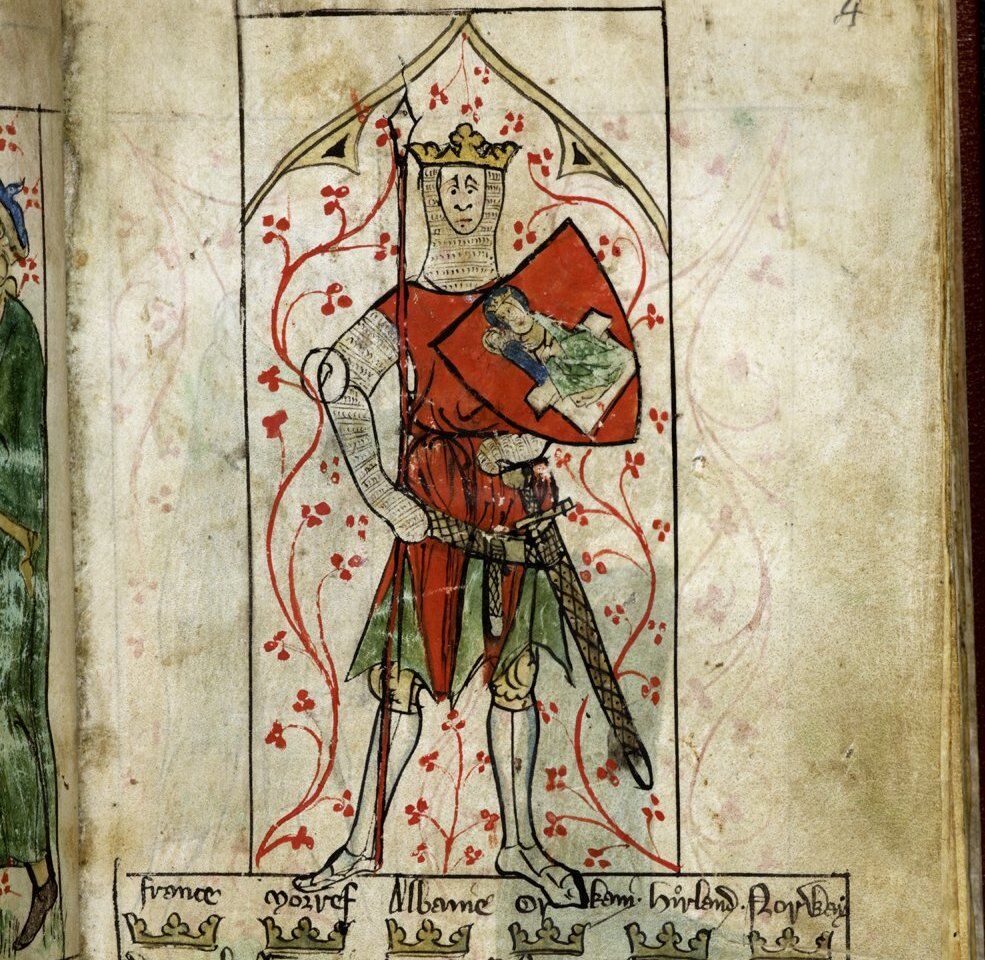
In one battle, he carries the image of the Virgin Mary on his shoulders / shield, and the pagans are put to flight through the power of the Virgin.
Read that again. The first full Arthur we have is literally carrying Mary into battle against pagans. He is a Christian champion by definition.
Nennius also gives us the first full Vortigern story — and the first Merlin.
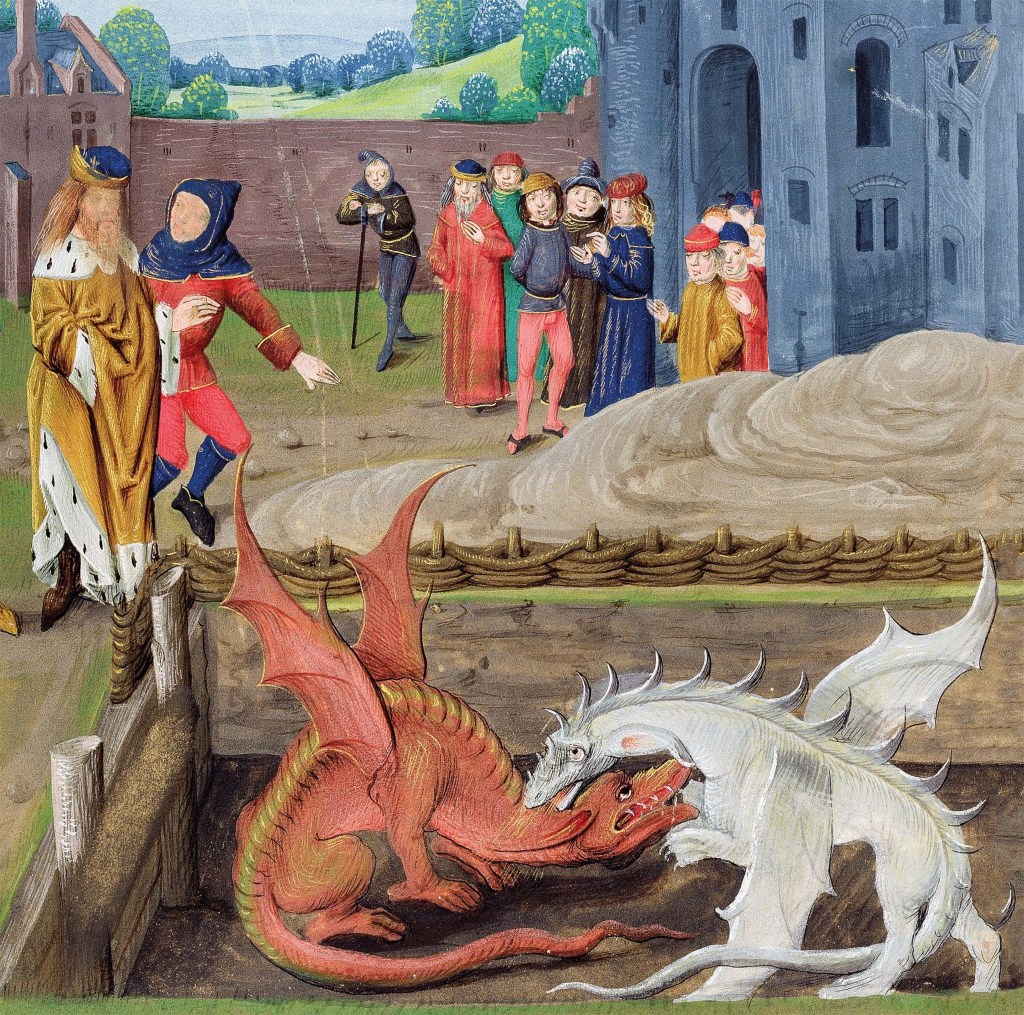
Vortigern tries to build a tower that keeps collapsing. His wise men tell him to kill a boy with no father and sprinkle his blood on the foundations. They find that boy: Ambrosius, who becomes Merlin.
The boy doesn’t do druid magic. He reveals the reason for the collapse: two dragons fighting underground, a red one and a white one. And then he prophesies. He interprets the dragons as the Britons and the Saxons, and foretells the coming of Ambrosius Aurelianus and then Arthur.
That is not a pagan wizard. That is a biblical prophet.
2. Geoffrey of Monmouth Invents The Arthur We Know — And He’s A Cleric Too
If Gildas, Bede, and Nennius give us the seeds, Geoffrey of Monmouth, c. 1136 — Historia Regum Britanniae — gives us the tree.
Geoffrey was a cleric, probably a canon at Oxford, later Bishop of St Asaph. And he is the man who actually invents most of what we think of as “Arthurian legend”: Uther Pendragon, Merlin as a major character, the sword in the stone’s predecessor, Arthur’s conquests, Mordred, the whole sweep.
And Geoffrey’s Merlin is, above all, a prophet.
Geoffrey even wrote a separate work, the Prophetiae Merlini — The Prophecies of Merlin — before he finished the Historia, and then folded it in. In it, Merlin delivers a long, obscure, apocalyptic prophecy about the future of Britain: dragons, boars, lions, the coming of kings, the fall of empires.
Medieval readers didn’t read that as fantasy. They read it the way they read Isaiah or Revelation. Merlin was treated as a Christian prophet — a sort of British Jeremiah who could see God’s plan for the nation. Scribes copied his prophecies separately. Kings tried to use them for propaganda. People wrote commentaries on them trying to figure out what they meant for the present day.
In Geoffrey, Merlin is also given a famous origin: son of a demon and a human mother. That sounds pagan and spooky to modern ears, but to a medieval Christian audience, it was a theological puzzle Geoffrey was deliberately playing with. How can a child of a demon be good? Because he is baptized. Because God can use even a demonic origin for holy purposes. Merlin’s power is not separate from Christianity. It is explained by Christianity.
This is also where Vortigern’s story becomes fully Christian moral history. Vortigern isn’t just a bad king. He’s a lustful, prideful sinner who marries Hengist’s pagan daughter, murders his own son, and brings down divine punishment on Britain. His tower fails because God wills it. Merlin explains God’s will.
The whole structure is: sin -> punishment -> prophet -> divinely chosen deliverer (Arthur).
3. The “Later Medieval Additions” Are Even More Christian
People often think the later romances are where the pagan stuff creeps back in. It’s the opposite. The later Middle Ages make Arthur more Christian, not less.
Wace and Layamon take Geoffrey and turn him into vernacular romance, but they keep Arthur as a Christian king defending Christendom.
Chrétien de Troyes in the 12th century gives us Lancelot and Perceval. Perceval’s story is a story of sin, ignorance, and learning to be a Christian knight.
Then comes the Vulgate Cycle and Malory’s Le Morte d’Arthur (1485) — and this is where the Grail takes over.
The Holy Grail is not a pagan cauldron of plenty that Christians borrowed. In the Vulgate Cycle, it is explicitly the cup of the Last Supper, brought to Britain by Joseph of Arimathea, the man who buried Christ. The Grail Quest is not a magical treasure hunt. It is a spiritual pilgrimage. Only the purest knight — Galahad, the virgin knight — can achieve it, because the Grail is a vision of God.
The Fisher King is wounded because of sin. The Waste Land is wasted because of sin. The kingdom can only be healed by a Christian knight achieving grace.
Lancelot fails the Grail Quest because he is an adulterer. That’s not a side detail. That’s the entire moral theology of the later Arthurian tradition: chivalry without chastity and Christian devotion is not enough.
Even the magic is Christianized. Morgan le Fay, in the later romances, is not a pagan goddess. She is a fallen, educated woman who learned necromancy — which, in medieval theology, is demonic magic. Merlin himself eventually falls because of lust for the Lady of the Lake. His downfall is a moral warning, not a pagan tragedy.
If you remove Christianity from Malory, you don’t get a purer Arthur. You get no Arthur at all.
So Why Do We Think Arthur Was Pagan?
Because the Victorians and the 20th century invented that Arthur.
Tennyson, the Pre-Raphaelites, then later fantasy writers, neo-paganism, and modern TV wanted a Merlin who was a druid, an Arthur who was a Celtic hero, a Britain that was pagan before the mean Christians arrived.
It’s a lovely aesthetic. It’s just not medieval.
The medieval writers would have been baffled by it. For them, Arthur’s whole point was that he was the last Christian Roman Briton standing against pagan invaders. Merlin’s whole point was that he was a prophet who revealed God’s plan.
That’s why The Pendragon Cycle feels so Christian. It’s not adding something alien to the legend. It’s actually going back to the sources — to Gildas’s sinful Britain, to Bede’s Ambrosius Aurelianus, to Nennius’s Mary-carrying Arthur, to Geoffrey’s prophet Merlin.
The show isn’t ruining Arthur by making him Christian.
The show is remembering that Arthur was Christian all along.



Leave a Reply