
Margaret Beaufort: Survivor, Rebel Kingmaker by Lauren Johnson ISBN:978-1789541632
November 6th 2025, Head of Zeus
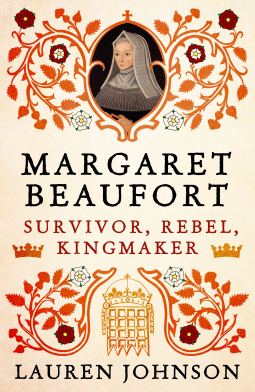
Survivor. Rebel. Conspirator. Matriarch of a dynasty.
Born into a century of conflict as the daughter of the Duke of Somerset and a descendant of Edward III, Margaret Beaufort was married at twelve, a mother and widow at thirteen, and a player in one of the most violent chapters of English history.
Across three marriages and decades of civil war, Margaret endured loss, intrigue and exile – yet lived to see her only son crowned Henry VII, the first Tudor king. Against a backdrop of shifting power and danger, she helped broker the union that ended the Wars of the Roses, shaped the early Tudor court, and played a formative role in the life of her grandson, Henry VIII.
In this powerful and perceptive biography, historian Lauren Johnson brings Margaret vividly to life as a woman of rare resilience and ambition. With empathy and sharp insight, Johnson reframes our understanding of medieval power and restores Margaret to her rightful place: not simply a mother behind the throne, but a skilled political operator whose determination changed the course of English history.
Rating: 4.5/5 stars
Lauren Johnson’s biography of Margaret Beaufort is a masterful exploration of one of medieval England’s most remarkable women. Born into the highest echelons of the aristocracy as the daughter of the Duke of Somerset, married at twelve, widowed and a mother at thirteen, Margaret Beaufort’s life reads like something from a dramatic novel—except it’s all meticulously documented history. Johnson presents a nuanced, well-rounded portrait that doesn’t shy away from Margaret’s flaws alongside her undeniable strengths, making for a far more interesting and human subject than the one-dimensional saint or schemer often depicted in popular history.
Johnson’s Approach and Style
Having enjoyed Johnson’s previous works, I found her writing style both engaging and accessible without sacrificing scholarly rigour. She has a gift for bringing the late medieval world to life, making the complex political landscape of the Wars of the Roses comprehensible to modern readers whilst never condescending to her audience. The narrative flows smoothly, carrying readers through decades of upheaval with clarity and purpose.
One of this biography’s particular strengths is its equal attention to Margaret’s life after Bosworth. Too often, biographies of medieval women lose momentum once their subject’s main “story” concludes—in Margaret’s case, once her son Henry Tudor claimed the throne in 1485. But Johnson demonstrates that Margaret’s influence, patronage, and political manoeuvring during her son’s reign are just as fascinating as her earlier struggles for survival and advancement. Her role in arranging the marriage between Henry VII and Elizabeth of York, her considerable influence at court, her involvement in raising the future Henry VIII, and especially her extraordinary patronage of learning and the arts all receive the detailed attention they deserve.
Confronting Uncomfortable Truths
Johnson doesn’t pull punches when examining the political landscape of the Wars of the Roses, and readers who come to this book with strong partisan feelings about the key players should be prepared to have their assumptions challenged. Richard III partisans in particular may find some sections difficult reading. Johnson presents well-documented examples of Richard’s behaviour that complicate the rehabilitated image some modern writers have tried to construct.
The treatment of the elderly Countess of Oxford stands out as particularly revealing. Johnson details how Richard III threatened to forcibly evict the Countess from her home and compel her to undertake an arduous journey in the depths of winter—a journey that could well have killed a woman of her advanced years. This wasn’t mere political manoeuvring; it was calculated cruelty designed to force the Countess to sign over control of her lands. Johnson presents these facts straightforwardly, allowing readers to draw their own conclusions about Richard’s character and methods, but the implications are clear. Such episodes provide important context for understanding why figures like Margaret Beaufort worked so determinedly against Richard’s regime.
Political Acumen and Family Dynamics
Where this biography particularly excels is in its examination of Margaret’s political involvement and her complex relationships with family members. Johnson positions Margaret as an active agent in the tumultuous politics of her age rather than merely a fortunate survivor who happened to be in the right place at the right time. We see Margaret’s strategic thinking, her careful cultivation of relationships, her willingness to take calculated risks, and yes, her ruthlessness when necessary.
The book explores Margaret’s relationships with her various husbands—each marriage serving different purposes at different stages of her life—and her often fraught relationship with her son Henry VII. Johnson doesn’t present Margaret as the perfect mother or the ideal medieval lady; instead, we see a woman whose ambition sometimes conflicted with maternal feeling, whose piety coexisted with political calculation, and whose determination to secure her son’s position sometimes created tension with that same son once he was securely king.
How This Compares
Those familiar with Nicola Tallis’s biography of Margaret will find Johnson’s approach complementary rather than redundant. Whilst Tallis delves more deeply into Margaret’s personal and devotional life—her religious observances, her personal correspondence, her daily routines—Johnson emphasises her political involvement and family dynamics. Read together, these two biographies provide a remarkably full picture of this complex woman. Johnson’s focus on politics and power makes her biography feel more dynamic and forward-moving, whilst Tallis offers a more intimate portrait. Both are valuable, and readers seriously interested in Margaret Beaufort will want to read both.
Margaret’s Legacy
One of the most moving aspects of Johnson’s biography is her attention to Margaret’s later life and her extraordinary legacy. By the time of her death in June 1509—just two months after the son whose birth had nearly killed her—Margaret had founded a professorship of divinity and two colleges at Cambridge University. Her patronage extended to countless scholars, artists, and religious institutions. Johnson argues convincingly that Margaret’s intellectual and cultural legacy may be as significant as her political achievements, and that the woman who could barely see her son during his exile became the matriarch who helped shape the cultural flowering of the early Tudor court.
Final Thoughts
This is an excellent choice for general readers seeking an introduction to Margaret Beaufort, Tudor enthusiasts wanting a fresh perspective on the dynasty’s origins, and anyone interested in medieval women’s agency and power. Johnson has given us a Margaret Beaufort who is shrewd, resilient, flawed, and utterly compelling—a woman whose story deserves to be told with exactly this level of nuance and care.
Margaret Beaufort’s life spanned some of the most turbulent decades in English history, and she not only survived but thrived, ultimately achieving the seemingly impossible goal of placing her son on the throne. Johnson’s biography does justice to this remarkable achievement whilst never losing sight of the human costs and moral complexities involved. It’s a must-read for anyone interested in the Wars of the Roses, the Tudor dynasty, or the lives of medieval women who wielded power in a world that offered them few avenues to do so.
I received an advance review copy of this book from NetGalley in exchange for an honest review.

 The History Lady
Leave a comment