December 25-29, 1170
This week marks the anniversary of one of the most shocking events in medieval English history: the brutal murder of Archbishop Thomas Becket in Canterbury Cathedral on December 29, 1170. But the story truly begins four days earlier, on Christmas Day, when Becket made a fateful decision that would seal his doom.
Christmas Day: Excommunication and Defiance
On December 25, 1170, Thomas Becket stood in Canterbury Cathedral and preached a sermon that demonstrated both his courage and his uncompromising nature. He had only recently returned to England after six years of exile in France, following a bitter dispute with King Henry II over the rights and privileges of the Church.
The fragile reconciliation that had allowed his return was already unraveling. Just months earlier, in June 1170, Henry had arranged for his son, Henry the Young King, to be crowned by Roger de Pont L’Évêque, Archbishop of York. This was a deliberate insult to Becket’s authority—traditionally, only the Archbishop of Canterbury had the right to crown English monarchs. The ceremony had taken place in Becket’s absence and without his consent.
Becket’s response was swift and uncompromising. Shortly before landing in England in early December, he had issued letters excommunicating Archbishop Roger of York, along with Gilbert Foliot, Bishop of London, and Josceline de Bohon, Bishop of Salisbury—all of whom had participated in the unauthorized coronation.
Now, on Christmas Day, Becket made his position crystal clear. Standing before the congregation in his cathedral, he thundered his condemnation of the bishops who had violated his rights, reportedly declaring “May they all be damned by Jesus Christ!”
It was a bold move, but also a dangerous one. The excommunicated bishops immediately appealed to King Henry, who was in Normandy at the time. When they arrived at his court with news of Becket’s actions, the king’s fury was terrible to behold.

“Will No One Rid Me of This Turbulent Priest?”
According to contemporary accounts, Henry flew into one of his legendary rages upon hearing of Becket’s latest defiance. The exact words he spoke have been debated by historians, but the most famous version has him crying out: “Will no one rid me of this turbulent priest?”
Whether Henry intended these words as a direct command or merely as an expression of frustrated anger, we will never know. But four knights—Reginald FitzUrse, Hugh de Morville, William de Tracy, and Richard le Breton—took them as a royal order. They slipped away from the court and crossed the Channel to England, determined to confront the archbishop.
According to tradition, the four knights stopped at Saltwood Castle in Kent, just a few miles from Canterbury. This castle, which belonged to the Archbishop of Canterbury but had been seized by the king, provided an ideal staging point for their deadly mission. Here, in the hall of Saltwood, the knights are said to have finalized their plans. The castle still stands today, largely intact, a silent witness to the conspiracy that would shock medieval Christendom.
December 29: Murder in the Cathedral
The four knights—Reginald FitzUrse, Hugh de Morville, William de Tracy, and Richard le Breton—arrived at Canterbury on the evening of December 29, 1170. According to eyewitness accounts, particularly that of Edward Grim, a monk who was present and was himself wounded in the attack, the knights first hid their weapons and armor before entering the cathedral.
They found Becket in a side chamber and demanded that he lift the excommunications and come with them to Winchester to answer for his actions before the king. Becket refused. He would not back down, would not compromise, would not submit to royal authority over the Church.
The knights left briefly, then returned with their weapons. As tension mounted, Becket’s companions urged him to flee or seek sanctuary. Instead, he proceeded calmly to the cathedral for vespers. When the other monks tried to bolt the doors for safety, Becket ordered them reopened, declaring “It is not right to make a fortress out of the house of prayer!”
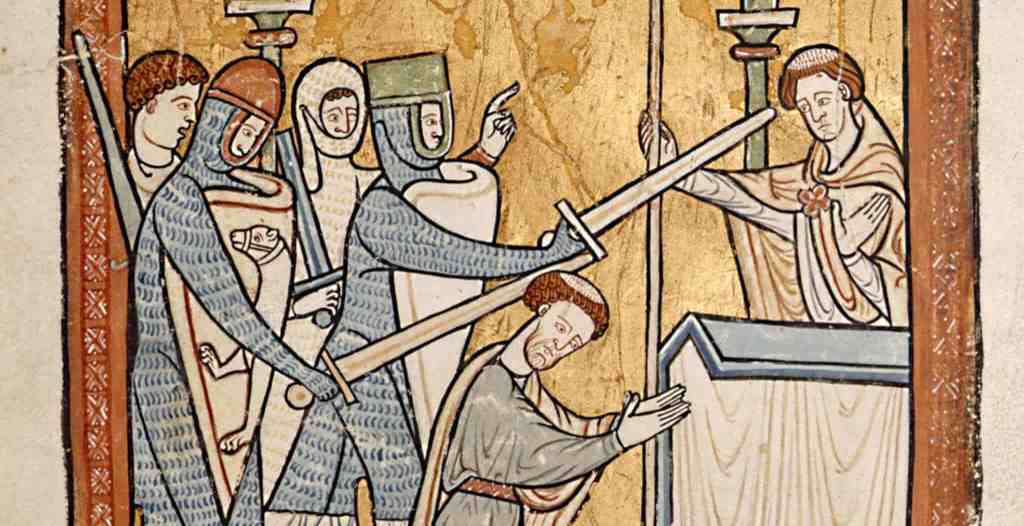
The knights burst into the cathedral with swords drawn. They tried to drag Becket outside, but he held fast to a pillar. What happened next shocked medieval Christendom to its core.
In the gathering darkness, near the altar of his own cathedral, the knights struck Becket down with their swords. The blows were brutal—one knight sliced off the top of his skull, scattering his brains across the stone floor. According to Edward Grim, Becket’s last words were: “For the name of Jesus and the protection of the Church, I am ready to embrace death.”
The Aftermath: From Controversial Archbishop to Martyr
The murder sent shockwaves through Europe. A prince of the Church, the Archbishop of Canterbury himself, had been cut down in his own cathedral—on consecrated ground, in a sacred space. The brutality of the act, and its location, transformed Becket almost overnight from a controversial, quarrelsome figure into a martyr for the faith.
King Henry, realizing the magnitude of what had been done in his name, moved quickly to distance himself from the murder. He sent emissaries to Pope Alexander III protesting his innocence, claiming he had never ordered Becket’s death. The four knights fled north to Knaresborough Castle, and though Henry did not arrest them or confiscate their lands, neither did he help them when they sought his advice. Pope Alexander excommunicated all four assassins, who eventually traveled to Rome seeking forgiveness. They were ordered to serve as knights in the Holy Land for fourteen years.
For Henry, the consequences were severe. In 1174, he performed public penance, walking barefoot to Canterbury Cathedral to beg forgiveness at Becket’s tomb. But by then, Becket had already been canonized as a saint by Pope Alexander III in 1173, just three years after his death.
Reports of miracles at Becket’s tomb spread rapidly across Europe. Canterbury Cathedral became one of the most important pilgrimage sites in Christendom, drawing visitors from across the medieval world. The shrine would remain a focus of devotion until its destruction during the Reformation in the sixteenth century.
A Tragedy of Friendship and Principle
The story of Thomas Becket’s murder is ultimately a tragedy of two former friends. Henry and Becket had once been inseparable—contemporaries said they “had but one heart and one mind.” As Chancellor, Becket had been Henry’s most trusted adviser, helping him establish law and order across the realm.
But when Henry made Becket Archbishop of Canterbury in 1162, expecting him to serve royal interests in the Church, Becket transformed himself. He renounced his position as Chancellor, adopted an austere lifestyle, and defended Church rights with an uncompromising fervor that infuriated his former friend.
The dispute centered on fundamental questions: Could the Church be independent of royal authority? Should clergy accused of crimes be tried in Church courts or royal courts? Who had the ultimate authority in England—king or archbishop?
Neither man would compromise. Both were stubborn, proud, and convinced of the righteousness of their cause. The result was six years of bitter conflict, culminating in those four fateful days between Christmas and December 29, 1170.
Becket’s excommunications on Christmas Day proved to be his last act of defiance. Four days later, he lay dead on the stones of his cathedral, his blood mixing with the cold floor. But in death, he won a victory that had eluded him in life. His martyrdom strengthened the Church’s position and reminded medieval rulers that there were limits to royal power—limits enforced not just by earthly weapons, but by the threat of divine judgment and popular outrage.
Today, visitors to Canterbury Cathedral can still stand on the spot where history’s most famous “turbulent priest” met his violent end, a reminder of the terrible cost when principle and power collide.
I’ve visited Canterbury Cathedral several times, and standing on the spot where Becket fell never fails to move me. The history feels tangible in a way that few other sites can match. I have a replica pilgrim badge depicting Thomas Becket—just like the badges medieval pilgrims would have purchased at Canterbury as proof of their journey and devotion to the martyred saint. These small tokens were worn proudly by travelers throughout Christendom, spreading Becket’s fame across Europe and serving as a tangible connection to one of the most important pilgrimage sites in the medieval world.

 The History Lady
Leave a comment