
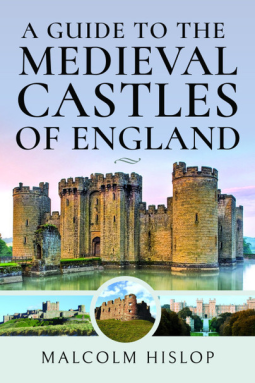
This is a well illustrated expert guide to the castles of England, providing concise accounts of what remains to be seen at each site. Spread across the medieval kingdom of England in a network of often formidable strongholds, castles, like cathedrals, are defining landmarks of their age, dominating their settings, in many cases even to this day. By representing an essential aspect of our history and heritage, the interpretation of which is constantly being revised, they demonstrate the value of Malcolm Hislop’s compact, authoritative and well illustrated new guide to English castles.
The gazetteer includes an astonishing variety of types, sizes and designs. Individual entries bring out the salient points of interest including historical context, building history and architectural character. The defensive and domestic purposes of these remarkable buildings are explained, as is the way in which their layout and role developed over the course of hundreds of years, from the predominantly earth and timber fortresses of the Normans to the complex stone castles of the later Middle Ages, many of which can be visited today.
Hislop’s experience as an archaeologist specializing in medieval buildings, castles in particular, as well as his eye for structural detail, ensure that his guide is a necessary handbook for readers who are keen on medieval history and warfare, and for visitors who are looking for an accessible introduction to these monumental relics of England’s military past.
A Serious Reference Guide for England’s Medieval Castles: Malcolm Hislop’s Expert Gazetteer
For anyone with a serious interest in England’s medieval castles, Malcolm Hislop’s comprehensive guide is an invaluable resource. This isn’t a coffee table book filled with glossy photographs and romantic descriptions of crumbling ruins. Instead, it’s a practical, authoritative reference work that prioritizes accurate information and architectural detail over entertainment value—and that’s precisely what makes it so useful.
What This Guide Covers
The book provides a gazetteer of castles across England, from the predominantly earth and timber fortresses of the Norman period through to the complex stone castles of the later Middle Ages. It’s worth noting that this guide focuses exclusively on England; readers looking for information on Scottish or Welsh castles will need to look elsewhere. For English castles, however, the coverage is comprehensive, encompassing an impressive variety of types, sizes, and designs.
Each entry provides essential information: when the castle was built, by whom, who owned it through the centuries, prominent inhabitants, and detailed descriptions of architectural features. Hislop brings his experience as an archaeologist specializing in medieval buildings to bear, ensuring that the information is both accurate and current with modern scholarship.
How I Used This Book
I didn’t read this guide cover-to-cover, and I don’t think that’s how most readers will approach it. Instead, I used the gazetteer to look up castles I know and have visited, as well as those local to me. This is where the book truly shines—as a quick reference guide, it’s ideal. Whether you’re planning a trip and want to know what to look for at a particular castle, or you’ve just returned from a visit and want to understand more about what you saw, Hislop’s guide provides exactly the information you need in a concise, accessible format.
Strengths: Glossary, Diagrams, and Detail
One of the book’s most valuable features is its illustrated glossary. Castle architecture comes with specialized terminology—curtain walls, merlons, crenellations, arrow loops, machicolations, keeps, baileys, barbicans—and Hislop doesn’t shy away from using the precise technical terms. The glossary ensures that even readers unfamiliar with architectural vocabulary can follow along and learn as they go.
The illustrated diagrams and floor plans are particularly useful, helping readers visualize the layout and defensive features of various castles. These aren’t merely decorative; they’re genuine aids to understanding how these structures functioned both as military fortifications and as domestic residences. Hislop excels at explaining the dual nature of castles—simultaneously homes and fortresses—and how their design evolved to balance these sometimes conflicting purposes.
The Technical Language Question
I should be honest about one aspect that some readers may find challenging: the language can be quite technical at times. Hislop writes with precision and uses proper architectural terminology, which occasionally makes the text feel a bit highbrow. You will likely find yourself referring back to the glossary more than once, especially when reading about the more architecturally complex later medieval castles.
However, I’d argue that this is actually a strength rather than a weakness, particularly when compared to other castle guides on the market. Hislop respects his readers’ intelligence and assumes they’re genuinely interested in understanding these buildings rather than just collecting pretty pictures. The technical language reflects the author’s expertise and ensures accuracy. Everything you need to understand the terminology is provided in the glossary—you just need to be willing to do a bit of work.
How This Compares to Other Castle Guides
I’ve previously read a guide to Scottish castles that took a much more colloquial approach, and while it was certainly easy to read, I found Hislop’s guide significantly more useful. The Scottish guide devoted considerable attention to movies filmed at various castles, pop culture references, and entertaining anecdotes. While this might appeal to some readers, I found myself frustrated by the lack of substantive architectural and historical information.
Hislop’s guide is refreshingly focused. Each entry tells you what you actually need to know: the castle’s construction date, its builders, its historical significance, who owned and occupied it, and its architectural characteristics. There are no digressions into which episode of a television series was filmed there or what famous ghost supposedly haunts the ruins. This stripped-down, informative approach makes the book far more valuable as a reference work.
Practical Applications
This guide is ideal for several audiences:
Trip Planners: If you’re organizing a castle-visiting tour of England, this book will help you understand what each site offers and what to look for when you arrive. The concise entries make it easy to compare different castles and decide which ones align with your interests.
On-Site Reference: The book is compact enough to bring along on castle visits. When you’re standing in front of a medieval gatehouse wondering about its construction date and defensive features, Hislop provides the answers.
Castle Enthusiasts: For readers with a serious interest in medieval military architecture, this guide offers the kind of detailed, accurate information that casual tourist guides often lack. Hislop’s background as an archaeologist ensures that the information reflects current scholarly understanding.
Armchair Travelers: Even if you’re not planning imminent castle visits, this guide allows you to explore England’s medieval heritage from home, providing enough detail to satisfy curiosity without overwhelming readers with unnecessary information.
Understanding Castle Development
One aspect I particularly appreciated is how Hislop traces the evolution of castle design across the medieval period. The book isn’t just a collection of isolated entries; it tells the larger story of how castles changed over time in response to developments in warfare, changes in domestic expectations, and shifts in political and social structures.
Early Norman castles were often earth and timber constructions—motte-and-bailey fortresses that could be erected quickly to establish control over newly conquered territory. As the Norman hold on England solidified, these temporary fortifications were increasingly replaced or supplemented with stone structures. By the later Middle Ages, castles had become extraordinarily sophisticated buildings, incorporating the latest developments in defensive architecture while also serving as comfortable aristocratic residences.
Hislop’s expertise allows him to explain these developments clearly, showing how each castle fits into this broader narrative of architectural and military evolution. You come away from the book with not just knowledge of individual castles, but an understanding of the larger patterns and trends in medieval fortification.
Final Thoughts
Malcolm Hislop’s guide is exactly what it claims to be: an expert, well-illustrated reference guide to England’s medieval castles. It’s a serious book for readers who want substance over style, accuracy over entertainment. The technical language may occasionally require referring to the glossary, but this is a small price to pay for a guide that treats its subject—and its readers—with appropriate seriousness.
If you’re looking for a lightweight introduction to castles with plenty of romantic descriptions and minimal architectural detail, this may not be the book for you. But if you want a reliable, comprehensive reference that will enhance your understanding and appreciation of these remarkable buildings, Hislop’s guide is an essential addition to your library.
For anyone planning castle visits in England, for enthusiasts wanting to deepen their knowledge, or for readers who simply appreciate expert guidance on medieval architecture, this book is highly recommended. It’s the kind of reference work you’ll find yourself returning to again and again.
Rating: 4/5 stars
Thanks to Pen and Sword for an ARC of this title via NetGalley. I wasn’t required to write a review.
Order any of my books today from Amazon, the Publisher Website or any good retailer

My new Bio of John Duke of Bedford is out now


 The History Lady
Leave a comment